Overview
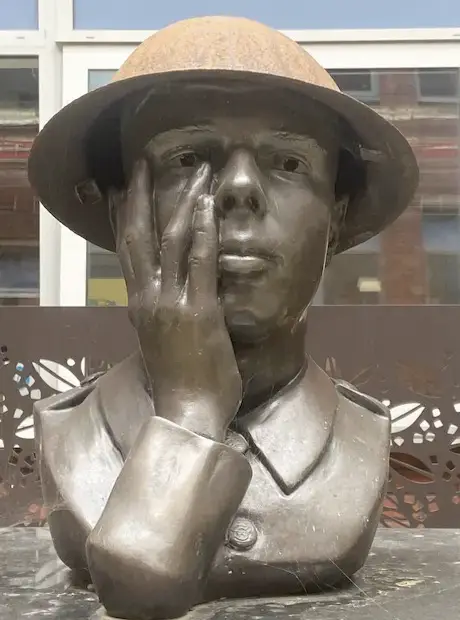
The Masks We Wear blends visceral, lyrical, and character-driven storytelling with immersive historical detail, exploring the aftermath of war through a deeply personal lens. Grounded in a single timeline, it follows a working-class family’s journey through trauma, moral conflict, and hard-won grace. Unlike some modern war fiction that leans on provocation or fragmentation, my novel delivers psychological realism and redemptive depth—trusting the war itself, and those who endured it, to carry its weight.
I’m proud to say that my novel draws on decades of research, including firsthand accounts, memoirs, and my own travels to the Western Front, where a battlefield guide once shared a chilling tale of mass suicide passed down from her grandmother—an anecdote that shaped one of the book’s most haunting scenes. At its heart, this is a story about the men and women who bore the burden of war—on the front lines, in the factories, and at home—and what it means, then and now, to survive, return, and rebuild.
What Themes the Novel Explores
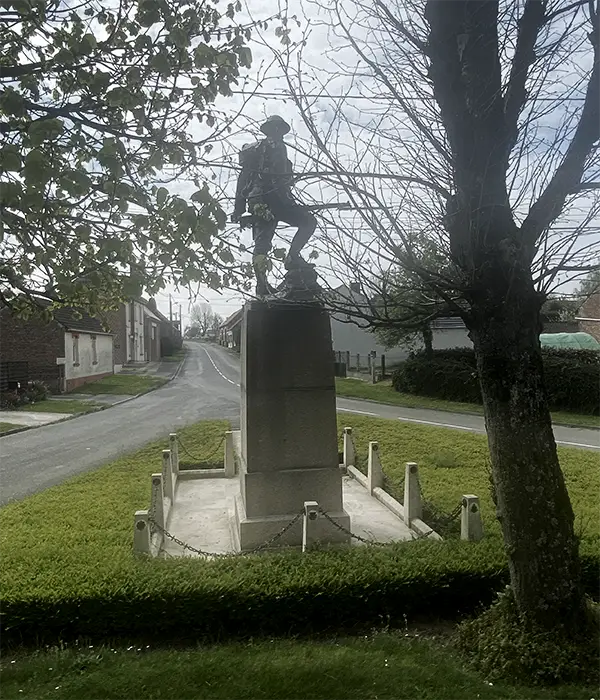
site of the first tank battle in history
- The men, women, and families who bore the burden of war—on the front lines, in the factories, and at home
- The critical role of women working in WW1 munitions factories
- Facial injury and the pioneering of modern plastic surgery
- Rehabilitation and the early treatment of physical and psychological trauma
- Friendship forged in crisis
- After the fighting ends – emotional and physical healing
Excerpt
In my novel, the reader is introduced to Archie Lane, a dental technician at Queens Hospital, Sidcup, England, who in 1917 helped transform the vision of rehabilitating injured soldiers’ faces from a wartime necessity into a new medical discipline. His hands-on work with dentures, prostheses, metallic masks, and dental/jaw supports — combined with his documentation — made much of what we consider “modern reconstructive surgery” possible. Here’s an excerpt:
Archie Lane held up to the light the pre-war photo of a lieutenant from the Bedfordshire Regiment. The man had high cheekbones, a Greek nose, and piercing eyes. The very embodiment of English aristocracy. He couldn’t help but notice what a handsome man he was—or rather, had been.
Before him on his work bench was a plaster cast of the man’s face now. Made by a modeler and his fellow colleague, Tom Kelsey, it looked like an unearthed Roman bust, yet somehow rendered beautiful with all its chips, divots, and imperfections. Shrapnel had gouged out his left eye and destroyed the bony orbit around the socket. While an artificial eye could be manufactured, without the existence of an intact orbit the eye socket tended to droop, sitting much lower on the injured side of the man’s face than on the non-injured. Surgery to restore the defect with a bone graft proved unsuccessful. So the doctors and the patient had resorted to a mask. That’s where Lane came in.
Primarily a dental technician, Lane was much sought after for the dental splints he made in his workshop. But his technical skill in fashioning dental prostheses and splints could also be used to make masks for men for whom surgery had failed. For his aristocratic lieutenant, he was working on an eye mask, complete with an artificial eye and painted eyebrows to cover the lieutenant’s drooping eye. The patient would need to wear wire rim spectacles to help conceal the artifice. A small price to pay. He painted the eye lids and cheeks in flesh tones, and then hung the eye mask on a stand to dry.
While the eye mask cured, he turned his attention to a full mask. To be made for an Australian infantry corporal. Lane read his army history. Typical Digger. Brash, disdainful of army discipline. Twenty-six days of Field Punishment No. 2 for a variety of offenses. Yet he displayed undaunted courage, was awarded the Military Medal in 1916. His number came up in July that year. Struck by an explosive bullet near Villers-Bretonneux. The bullet entered under his lower jaw and traversed his face. He endured eight operations in all, but despite the extensive surgery, the end result was not attractive. Had the bullet ricocheted downward instead of upward, his appearance—and life—would’ve been much better for the coincidence.
The corporal ended up losing his right eye and cheekbone. Half his nose and most of his palate were torn away, leaving him—even after surgery—with one of the most horrific faces of any soldier he’d seen. And he’d seen many. A mask was his only hope.
Lane had taken the original cast of the corporal’s face and filled it with Plasticine to recreate a normal contour. Another cast was taken from this mold. He’d then beaten a thin metal plate over the second cast. Hence, the “Tin Faces” for which his workshop was named. As he beat the tin mask into shape, he opened the closed eye and built up the missing contours for the missing cheekbone. Though a humble man, Lane felt at times like he was God creating man anew. If not in his own image, at least with a face that would be recognizable to the corporal’s family and loved ones.
Lane knew the masks were imperfect and uncomfortable, but what else did these men have? A prosthetic mask could never hide the shocking rawness of damaged flesh and bone, but could at least restore the semblance of humanity. It was sad to think that—just six months ago—these men were the pictures of youth, confident in their good looks and future potential.
Lane placed the tin mask on a nearby rack, ready for the next stage. Painting, eyelash and eyebrow application, the fitting of spectacles. He took a breath, looking up at all the faces he’d created over the last year with plaster casts and tin masks, hung on the walls of his workshop, staring back at him intently. One man’s smile was so broken it wore a permanent snarl, like a growling dog. Another had all its features intact, except for a bumpy forehead, protruding lips, and a hole where the right eye should’ve been.
For most people, his workshop looked like a haunted house. Or perhaps a museum, but not one displaying busts from antiquity. It was gallery of gargoyles, strange creatures conjured from the mind of their creator, a Dr. Frankenstein for a new, catastrophic age.
But to Lane, the plaster casts on the wall showed progress. For the doctors, each a step forward in learning how to mend broken men—whether by surgery or cosmetology. And for the patients themselves, an opportunity to see how their appearances could improve, and hopefully, their lives. Lane reflected that any doctor, artist, or technician could devote their own lives to far less worthy an endeavor.
His reverie was interrupted by a knock at his door.
“Yes, who’s there?”
“It’s Nurse Walters. I have two men here whom I’d like you to meet.”
Endorsements
This soul searching tale of friendship, love and sacrifice takes hold of you and won’t let go. You can’t help but follow these characters to the riveting end. McCormick’s talent for story telling shines!
Zu Vincent, Author of The Lucky Place